

In an increasingly alarming pattern, the UK Legal Aid Agency (LAA) has come under scrutiny for its lack of decisive action against solicitors accused of exploiting the legal aid system. Despite receiving reports of misconduct involving millions of pounds of public funds, critics argue the agency deflects responsibility, leaving vulnerable defendants at the mercy of unscrupulous legal practitioners.
The issue centers on firms like Rustem Guardian Solicitors and Whitelock & Storr Solicitors, who are alleged to orchestrate systemic fraud under the guise of legal aid representation. Concerns include "client poaching" and improper transfer requests aimed at maximizing legal aid payments rather than effectively representing clients. These transfers allow firms to inflate fees, particularly in complex cases where high page counts result in significant payouts from the LAA.
A letter from Jane Harbottle, Chief Executive of the LAA, dated January 2023, exemplifies the agency's passive response. While acknowledging the allegations and forwarding concerns to the Counter Fraud & Investigation Team (CFI), the letter reveals that fraud investigations are outsourced with no transparent follow-up or accountability for outcomes. Critics highlight this process as emblematic of a broken system that neither deters malpractice nor prioritizes the safety and fairness of convictions.
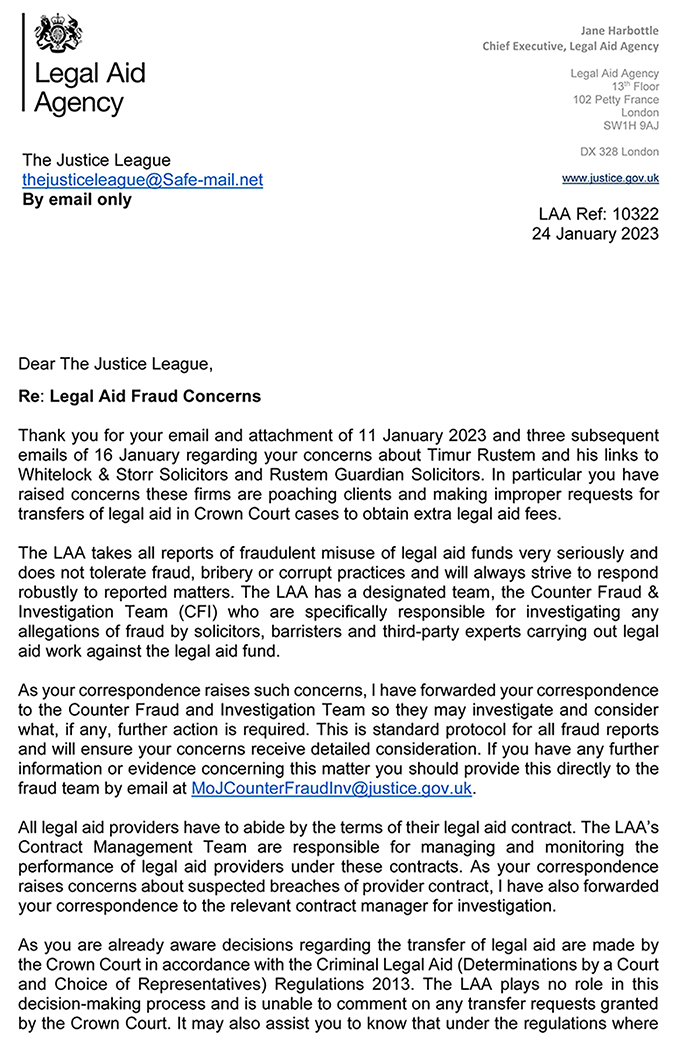
"The LAA claims to take fraud seriously, yet their actions suggest otherwise. They pass complaints to counter-fraud teams that do nothing while defendants wonder why their cases are being run like a circus," said a whistleblower familiar with the system.
Defendants often face mounting pressure to plead guilty on the day of trial, a tactic critics say is exploited to extract maximum fees from the agency. For example, in cases involving tens of thousands of pages of evidence, legal aid firms can claim upwards of £80,000 per case, regardless of the quality of representation. Such practices not only defraud taxpayers but also raise serious questions about conviction safety.
Observers allege the misconduct extends beyond isolated firms, suggesting a "cartel-like" system involving a network of firms operating on an industrial scale. Despite the obvious risk to judicial integrity, the government and legal regulatory bodies appear unwilling to confront the issue, fearing the damage it could do to public trust in the justice system.
Calls for Reform
Campaigners are urging the LAA and the government to take immediate action. Suggested reforms include independent oversight of fraud investigations, stricter controls on legal aid transfers, and harsher penalties for firms found guilty of malpractice. Critics argue that without such measures, the credibility of the UK’s legal aid system—and by extension, its judicial system—will continue to erode.
As public outcry grows, defendants and advocacy groups are calling for systemic change, emphasizing the profound impact these fraudulent practices have on lives and the integrity of the justice system. "This isn't just about stolen money; it's about stolen justice," one advocate stated. "The system is failing those it was designed to protect."
The LAA has yet to respond to mounting demands for transparency and reform, leaving questions about the future of legal aid unanswered. For now, defendants and taxpayers alike remain in a precarious position, victims of a system that appears more interested in passing the buck than addressing deep-seated issues.