
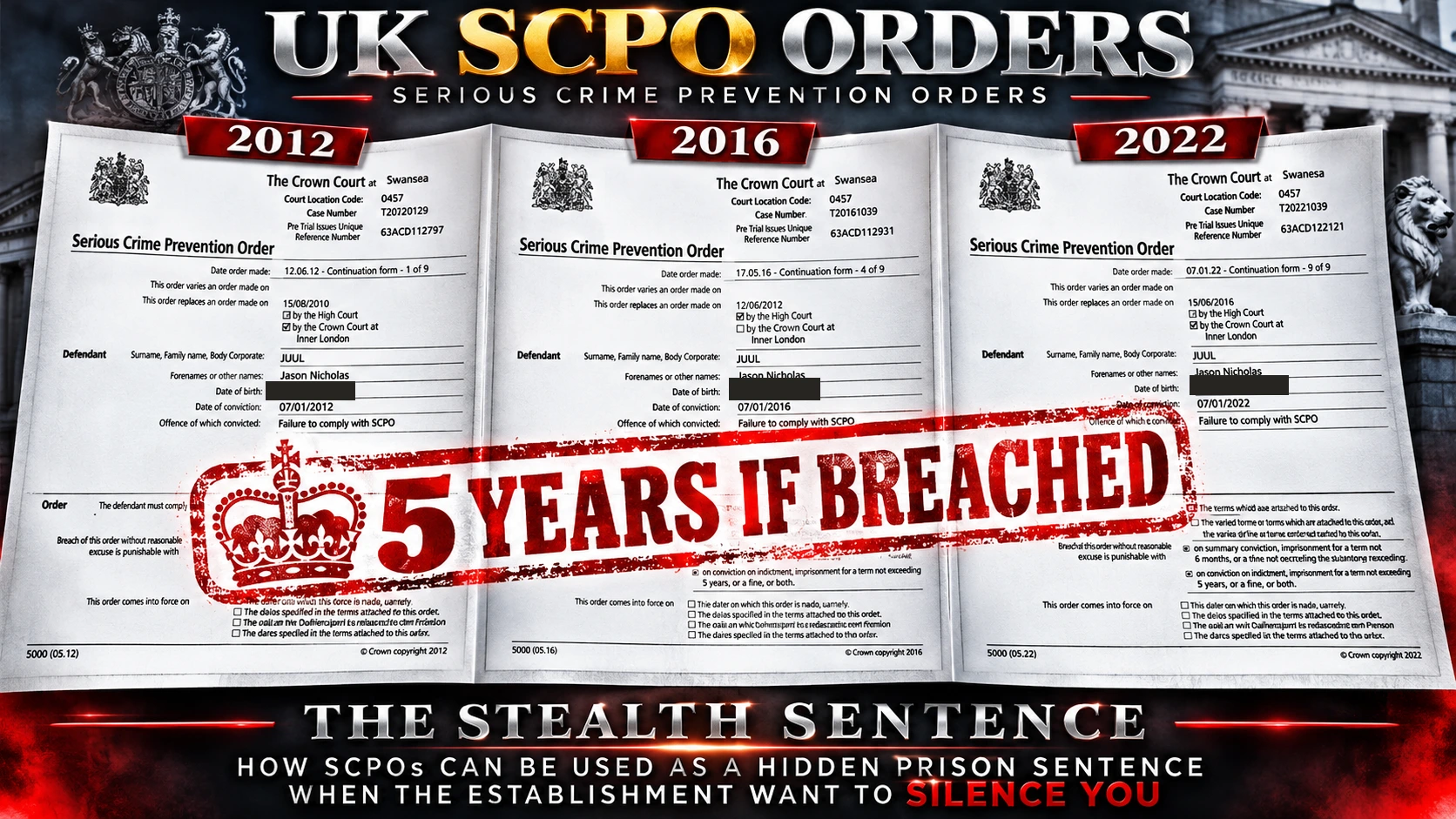
Cover illustration. The three signed orders linked below give the court names, dates and terms. On conviction on indictment, a breach can carry up to five years in prison.
On 10 April 2012, two months before Southwark Crown Court made the first of the three orders reproduced here, Caxess Corporation published a document on UK Indymedia. It was headed as an application to postpone a Southwark court fixture. The document alleged that state agencies had used Confidential Access and challenged the disclosure of evidence about a meeting with Barclays. Jason Juul, named Jason Nicholas Place on the Southwark order, says his later efforts to publish criticism brought him under renewed pressure. The headline gives his explanation for the succession of Serious Crime Prevention Orders (SCPOs). Read the April 2012 publication.
What was asked in Parliament?
On 14 May 2007, Mr Willis asked whether the Home Office sponsored or funded the Confidential Access website. Joan Ryan’s written answer was categorical: “The site in question is not sponsored or funded by the Home Office.” The question was about that department and those two activities. The wider allegations about who used the site came from the later publication. Read question 135311 and the minister’s answer in Hansard, column 546W.
The Indymedia document also cited a BBC item about false identity documents. When checked on 19 November 2026, the shorter BBC address redirected to the address printed in the document. That page returned the title Fraud expert examines fake ID, but the response ended before we could verify the full report or play the original footage. The Internet Archive has a capture dated 25 February 2011. Follow the original BBC link or open the archived BBC page.
Who attended the Barclays meeting?
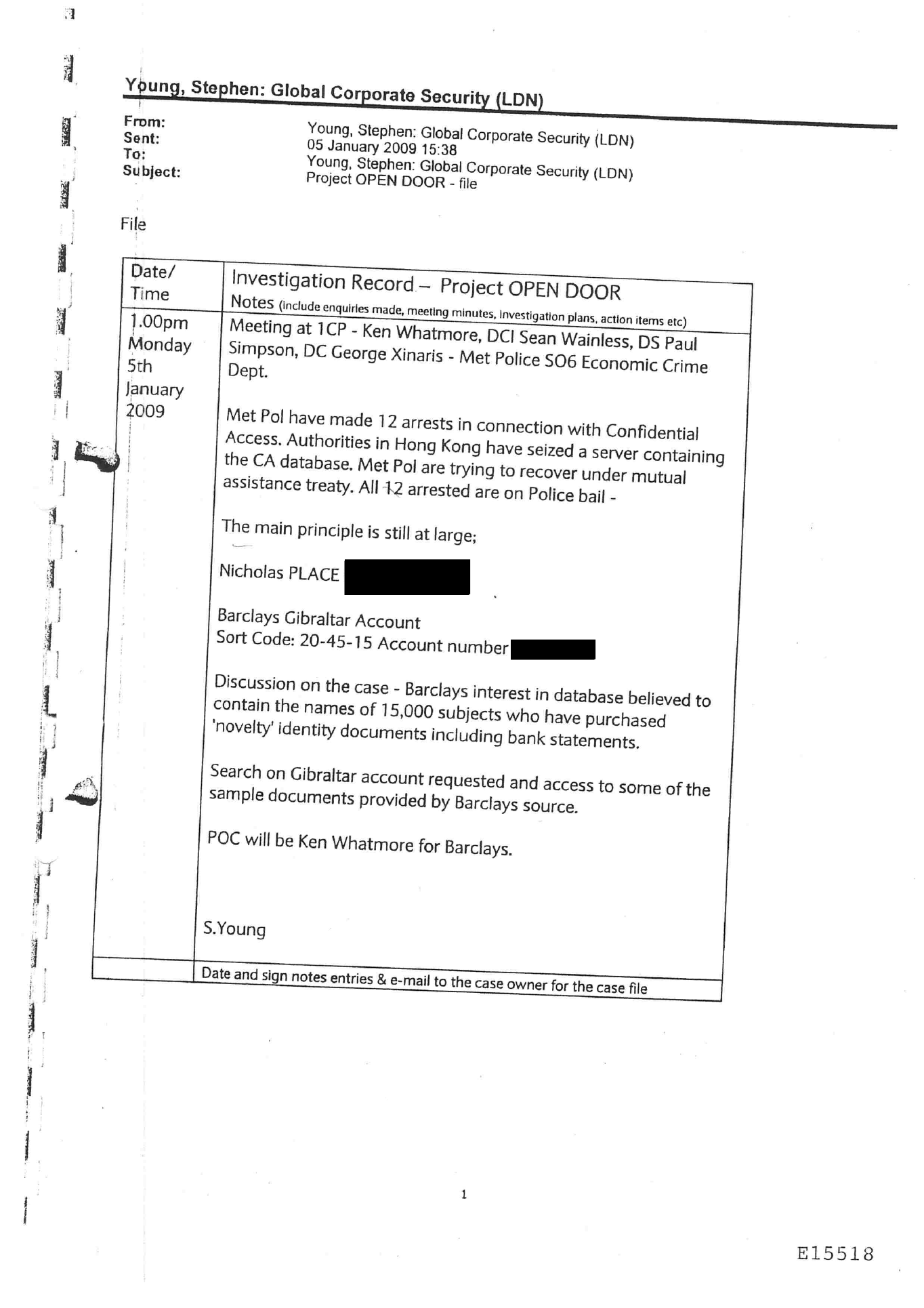
Stephen Young’s Project OPEN DOOR note records a meeting at 1pm on 5 January 2009. Young listed Ken Whatmore, “DCI Sean Wainless”, DS Paul Simpson and DC George Xinaris. He identified Whatmore as the Barclays point of contact. The note describes a discussion about the Confidential Access database and a request for access to sample documents. In the application published in 2012, the defence said the schedule of unused material disclosed no meeting between Xinaris and Young. That is the particular disclosure issue Juul points to. Read Young’s one-page meeting note (redacted copy).
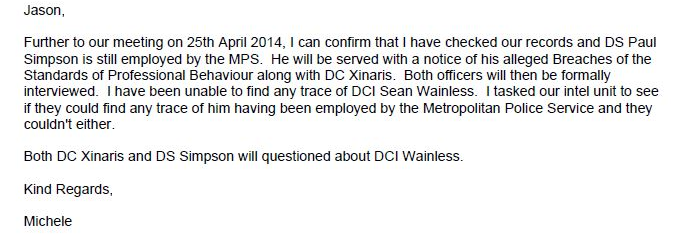
On 22 May 2014, Michele Cunningham wrote to Jason after meeting him the previous month. She said Simpson was still employed by the Metropolitan Police and that both he and Xinaris would be interviewed. She had checked for DCI Sean Wainless herself and asked the intelligence unit to check whether he had ever been employed by the Met. Neither search, she wrote, had found a trace. She said both officers would be asked about him. Read the May email excerpt.
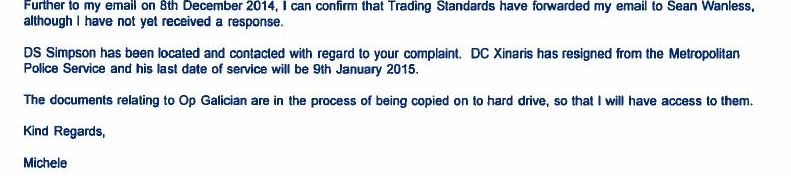
The December correspondence adds a lead and a different spelling. On 19 December 2014, Cunningham wrote that Trading Standards had forwarded her email to “Sean Wanless” and that she had yet to receive a reply. She also said Simpson had been contacted about the complaint and Xinaris had resigned, with a last day of service of 9 January 2015. Juul says every officer involved eventually resigned or took early retirement. This correspondence confirms one resignation. It gives no departure date for Simpson and leaves open who attended the meeting under the name and rank Young recorded. Read the December email excerpt. The email images show the message bodies with the address headers omitted.
The three orders and the websites they affected
8 June 2012 · Southwark Crown Court. The cover gives the June 2012 date. Some schedule sheets in the copy carry a March 2013 date. Page 5 sets out what had to be reported about devices and accounts, including email addresses and social-network usernames. It also requires devices to retain internet history. For someone whose work was building websites, these conditions reached the equipment he used each day. Read the Southwark order and schedules (10-page PDF).
“Welcome to HMP Wayland”
On 5 July 2012, Detective Inspector Karl Amos of the Metropolitan Police wrote to Place six days after his transfer from Wandsworth. The first sentence after the salutation was “Welcome to HMP Wayland.” The next paragraph told him that a financial disclosure was overdue. Amos gave him a further fortnight and warned that failure to disclose without reasonable excuse would be investigated. This correspondence concerned the Financial Reporting Order made at sentencing. It was a separate order from the Southwark SCPO.
On page two, Amos listed steps officers might take in custody, including monitoring mail and calls, vetting visitors, contributing to categorisation reviews and asking for Place to be moved to another cell, wing or prison. On 3 August, Rustem Guardian Solicitors wrote directly to Amos about his opening sentence. They called it inappropriate and demeaning and said they intended to raise it with senior officers and the Police Complaints Commission. The three pages include the objection, but no answer to it. Read the police letter and the solicitors’ reply (3-page PDF, prisoner number masked).
What was Wayland like when that letter arrived? Before the transfer, inspectors reported that a greater proportion of Wayland prisoners than at comparable prisons said they had felt unsafe there at some point. The inspection after the letter found slightly more violent incidents than at similar prisons, some serious. Neither inspection ranks Wayland as the UK’s most dangerous category C prison in July 2012. Read the 2011 inspection and the following inspection report.
DI Amos appears in the 2015 case
The same rank and surname appear three years later in the note of the Inner London Crown Court proceedings on 17 November 2015. Page 2 records the prosecution telling the jury that DI Amos had spoken by telephone to Gary Wilson in July and that Wilson had declined to give a statement. Navjot Sidhu QC is listed as giving evidence that day. The note records what the prosecution said about Amos’s part in the investigation. The police record extract in Juul’s papers separately records a guilty finding for stalking causing serious alarm or distress and a consecutive 48-month sentence on 15 December 2015. Read the note of proceedings, including the prosecution opening (PDF, page 2).
Juul calls it a vendetta. He says the officers worked as one unit and believes careers were sacrificed to keep him silent. The records give different organisational descriptions. Young’s 2009 note refers to the Met’s Economic Crime department. The 2012 letter carries the SCD3 Partnership & Prevention heading and names the Lifetime Offender Management Unit at New Scotland Yard. The 2015 proceedings identify DI Amos by rank and surname. Taken together, those entries trace one officer across two episodes. They leave the full team membership and chain of command unresolved. The complaint correspondence gives a service date for Xinaris and records that Simpson was contacted. It gives no reason for Xinaris’s resignation and does not identify who, if anyone, sought it.
In Inside Time on 1 April 2016, the writer connected ten breaches to the creation of CowboySolicitors.com and the use of a family laptop and an unregistered email address to rent a home. He described receiving a consecutive five-year sentence. His account was already in print before the Inner London order below was made. Read his April 2016 account.
15 June 2016 · Inner London Crown Court. The first page says this order replaced one made on 8 June 2014. A separate copy of that 2014 order is missing from this set. Page 10 gives the practical consequence for a publisher. To acquire a domain or server under paragraph 5.2, it had to be registered and hosted in the UK, and he had to give the police at least seven days’ written notice, with details and reasons. Paragraph 5.3 barred having someone acquire it on his behalf. Read the Inner London order (14-page PDF), especially page 10.
A separate Southwark court result dated 11 April 2017 records a successful appeal against a November 2016 harassment conviction. It also records a reduced restraining order governing contact with Navjot Sidhu QC. The outcome recorded on that sheet concerns the harassment case. The replacement history of the SCPO appears on the face of the Swansea order.
17 May 2022 · Swansea Crown Court. The cover identifies the June 2016 Inner London order as the one being replaced. Page 8 again requires seven days’ advance written notice and reasons for acquiring a UK-registered and UK-hosted domain or server. For Juul, that meant explaining a proposed acquisition to the supervising unit before he could go ahead. Read the Swansea order (11-page PDF), especially page 8.
DI Amos in the Southwark appeal transcript
Southwark Crown Court heard Jason Place’s appeal on 10 and 11 April 2017. The printed page numbers restart for the second day. Each link below opens the relevant scan in a 30-page selection from the 235-page file. The dates and page numbers on the cards are those printed in the transcript.
Who monitored Place under the order?
“the unit that to which Mr Amos and Mr Fox are attached which have responsibility for monitoring Mr Place’s situation”
Trollope was asking for time to see his client. He told the court that police had visited Place at Thameside when his legal team expected to see him. He said the visit apparently had nothing to do with the monitoring unit, transcribed as “Lomu(?)”. He added that Fox, who was in court, knew nothing about the visit. On page 17, counsel used the words “long-term offender management unit”. The Wayland letter above uses the name Lifetime Offender Management Unit.
Read the exchange on pp. 3–4 (PDF) · Read counsel’s description on p. 17 (PDF)
What did Sidhu’s “Yes” answer?
Trollope: “Yes. And in addition, they say that you colluded with Detective Inspector Amos in producing such a false statement, yes?”
Sidhu: “Yes.”
On page 59, Sidhu agreed he had given evidence at the trial that led to Place’s conviction on 15 December 2015. On page 60, “they” refers to Place’s complaints. Sidhu agreed that the complaints made the allegation. Earlier on the same page, he said he did not recall trial counsel suggesting he had colluded with the police. Reading the question with the answer matters here.
Who was in charge of the monitoring unit?
“Amos is the man in charge of this monitoring unit that is dealing with Mr Place’s case at the moment.”
In the preceding sentence Trollope called DI Amos “the officer in the case”. He was explaining why Place’s proposed private prosecution and correspondence referred to both Sidhu and Amos. This is counsel’s description of Amos’s role at the time of the appeal.
Where does the name SCO7 appear?
“In this self same statement, he accuses Mr Sidhu of deliberately helping SCO7, ie Mr Amos’ squad, at New Scotland Yard”
Trollope was describing what Place had written about Sidhu’s evidence at Inner London. Judge Griffiths then questioned counsel about the distinction between participating in a campaign and causing fear or distress. The reference to SCO7 is part of that argument. It identifies the squad as counsel described it without establishing who served in it.
How the complaint against Amos came before the court
“We are grateful to you for raising this issue and giving us the opportunity to review the actions of those concerned.”
Trollope read those words from a Metropolitan Police letter after describing Place’s complaint about Amos. His argument was that Place had taken a grievance to a body with responsibility for it. Later, counsel expressly said Amos was not a complainant in the appeal proceedings. The passage records the police acknowledgment and counsel’s argument about it.
Read the letter as quoted on pp. 42–43 (PDF) · Read counsel’s clarification on pp. 77–78 (PDF)
What the appeal actually decided
“So as far as we are concerned, the prosecution have not proved that this was harassment in those circumstances.”
The judge identified four letters sent in January and February 2016, after the 2015 stalking trial. The court accepted that Sidhu had experienced alarm and distress. It was not sure that, viewed objectively and in context, the four letters met the threshold for harassment. It therefore allowed the appeal against the Westminster conviction. The 2015 Inner London conviction was outside the scope of that decision. On page 128 the judge set out the narrower order governing future contact, with an exception for contact through regulated legal representatives.
Read the ruling on pp. 79–83 (PDF) · Read the terms of the order on p. 128 (PDF)
From the Swansea indictment to the discharge judgment
Fourteen charges on paper. Nine guilty pleas in court.
“FAILING TO COMPLY WITH A SERIOUS CRIME PREVENTION ORDER”
Each of the fourteen counts on the supplied indictment alleges a breach of the 2016 Inner London order. Counts 1–8 concern financial reporting, including credit cards, hire purchase and a claimed business association. Count 9 concerns premises abroad, counts 10–13 concern devices and storage, and count 14 concerns a postal address. The red handwritten comments are annotations on this copy. They do not record the court’s decisions on individual counts.
The later High Court judgment records nine guilty pleas on 7 January 2022 and concurrent twelve-month sentences on 11 March. The prosecution applied separately for a replacement order on 10 May. On 17 May HHJ Richards made the new five-year order, to begin on release. The indictment does not identify which five counts account for the difference between charges and pleas.
Read the annotated indictment (8 pages) · Read judgment paragraphs 23–29
Two different entries were challenged
“It is quite clear from this description that the entry of affray in the aforementioned field does not apply to this crime”
In the July response, police said that one field on the crime record showed affray while the narrative described an alleged failure to report bank accounts under an SCPO. They attributed the mismatch to a selection error. Juul’s concern was what happened if later decision-makers relied on the label. The July letter does not say who saw it or whether it affected a risk assessment.
The August determination concerns a different entry. The Police National Computer Bureau recorded a travel notification as a Travel Restriction Order. The force apologised, confirmed removal of the marker and said the error made no material difference. Paragraph 30 of the High Court judgment explains why both the error and the licence mattered: Juul needed his supervising probation officer’s permission to leave the UK. The judge recorded that he did not have permission for the June crossing.
Read the July explanation · Read the August determination and apology · Read judgment paragraph 30
What did the MAPPA unit actually confirm?
“This letter is to confirm receipt at the Dyfed Powys MAPPA Unit and to inform you that there will be an investigation into the matter.”
Juul’s October 2023 discharge application says he was managed at MAPPA level 3. He argued that an incorrect public-protection entry had followed him through custody. The coordinator’s October 2022 letter confirms receipt of his September complaint and proposes an independent panel. It gives neither his MAPPA category nor his management level. In November 2023 the investigating officer told him the report was in its final stages, subject to agreement by partner agencies. That email gives no panel finding.
Multi-Agency Public Protection Arrangements have two separate classifications. The local annual report distinguishes registered sexual offenders (category 1), violent offenders (category 2) and other dangerous offenders (category 3). The management level describes the coordination required. A reference to level 3 cannot establish a sexual conviction. None of the fourteen Swansea counts alleges a sexual offence. The dated allocation decision and the panel’s reasons would answer whether the affray entry played any part in Juul’s management.
Read the MAPPA acknowledgment · Read Juul’s account, paragraph 10 · Compare the local MAPPA categories and levels
What became of the discharge application?
“I do not consider that there has been a change of circumstances affecting the order.”
Juul asked the High Court to discharge the Swansea order. He relied in part on his residence abroad and the way restrictions had been administered. Mrs Justice Farbey explained that the discharge procedure required a change of circumstances affecting the order. Residence in Belarus had already been put before the sentencing judge. The High Court declined to entertain the application and dismissed the claim at paragraph 71.
The documentary trail establishes two recording errors and an investigation into a complaint. It also establishes the separate guilty pleas, the application for a replacement order and the reason the discharge claim failed. Whether an inaccurate entry reached a particular panel, altered a decision or reflected an agreement to silence Juul remains unresolved in these records.
Read the discharge application, printed p. 4 · Read the approved judgment, especially paragraphs 57–71
Why Juul calls it an attempt to silence him
Juul draws a line from the disclosure dispute to the breach proceedings he described in 2016. The website on which he criticised his legal representation featured in his account of those proceedings. Years later, buying a domain still meant giving the police advance notice of what he wanted it for. His mother, Grace, wrote in 2025 about keeping copies of calls and emails because a disputed notification could have consequences for the whole household. Read Grace’s letter in Inside Time.
The orders document those restrictions in the courts’ own words. Young’s note and Cunningham’s emails leave a question about one attendee’s identity. Juul sees a common purpose behind these events. None of the three orders records a finding that officials agreed to suppress his criticism. Read the related Jason Juul case file and documents.